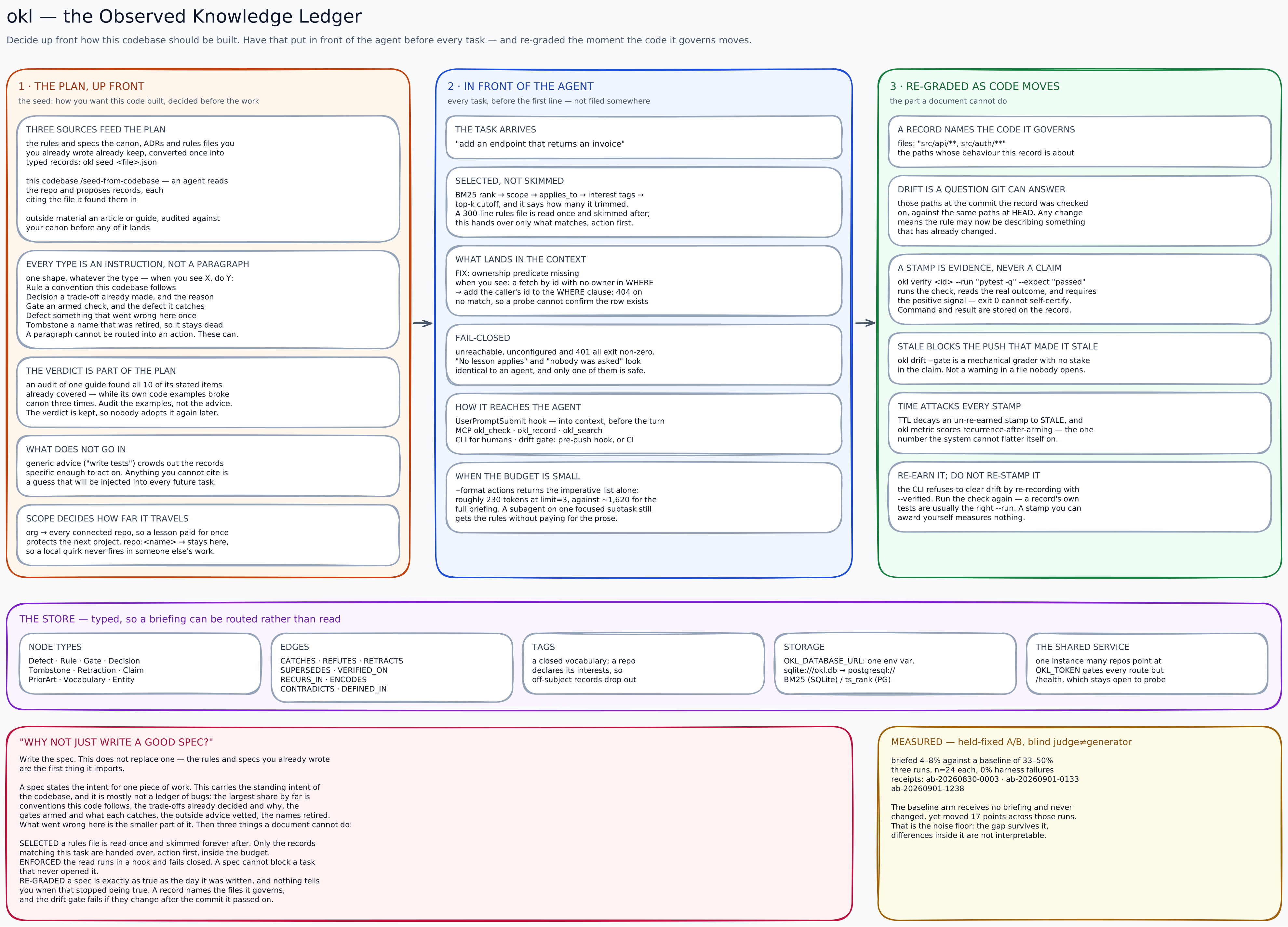
okl — Observed Knowledge Ledger
Lessons your coding agent can trust: briefed before each task, proven by checks, flagged on change.
okl — Observed Knowledge Ledger
A learning loop that keeps coding agents — and your docs — from drifting.
Engineering rules, architecture decisions, documentation and diagrams: recorded once, briefed to
Claude Code or any MCP agent before every task, proven by checks, and flagged in CI when what they
govern changes. Use it in one repo, or share one store across every repo your team runs.






🚀 Quickstart · 📘 Getting started guide · 🔬 How it works · 📊 Results · 🧪 Eval report · 🧩 Plugin
A small store of what a codebase knows — its conventions, architecture decisions and why they were made, the checks that catch mistakes already made once, and the claims its docs and diagrams make — plus a hook that hands the relevant ones to a coding agent (or a person) before they start a task. Each session can record what it learned, so the store grows with the work; it survives past a session and can be shared across a team. And it stays true: an entry is verified by running a check, and flagged when the files it governs change, whether those are code, docs or diagrams.
Quickstart
New here? docs/GETTING-STARTED.md walks through setup, the habit of adding to the canon as you build a feature, and keeping your docs from drifting.
1. Install the CLI (the PyPI name differs — PyPI refuses okl as confusable with
oki — but everything you type afterwards is okl):
pipx install 'observed-knowledge-ledger[mcp]'
Needs Python 3.10+ (and git for drift detection). Tested on macOS and Linux. Windows is untested: the core should work, but the Claude Code hooks likely need fixes there (#85).
2. Wire your repo. From the repository root:
okl init --repo my-repo --dry-run   # lists every file it would write; writes nothing
okl init --repo my-repo             # config, Claude Code hooks, MCP server, CI workflow, starter lessons
init detects your stack (*.csproj, package.json, pyproject.toml …), sets the repo's
interests from it, and fills the store with 20 starter lessons that hold on almost any
codebase plus the bundled packs for your stack, so the first prompt is already briefed
(--interests chooses your own subjects; --no-seed leaves the store empty).
init wires Claude Code when the repo has a .claude/ directory or claude is on your
PATH; --claude forces it and --no-claude skips it. --no-ci skips the GitHub Actions
workflow, for a private repo that would pay for its minutes or one that runs another CI,
and later runs remember that; --ci puts it back. Prefer the plugin? Install it
before running init — /plugin marketplace add emeraldleaf/okl, then
/plugin install okl@okl in Claude Code — and init leaves the hooks to the plugin, so
nothing is wired twice. (Installed after? okl doctor reports the double wiring, and
okl init --uninstall removes the project copy.)
3. Add a rule of your own. The starter lessons are generic; what pays is what only your
codebase knows. Tell your agent — "record an okl rule for this repo: order lookups are
scoped to the signed-in customer; governs app/orders.py" — and it records the lesson with
okl's okl_record MCP tool (in Claude Code, /record drafts it and asks you first).
Underneath, that is one CLI call you can also run yourself:
okl record --type Rule --scope repo --id order-owner-scope \
  --title "Order lookups are scoped to the signed-in customer" \
  --symptom "an endpoint fetches an order by id with no owner filter" \
  --fix "filter by the caller's customer id in the query; return 404 on no match"
More: okl seed lists every bundled pack; okl scaffold . stamps the method kit, which
includes a /seed-from-codebase command that has your agent propose cited records from
your own code (Seed it).
4. Check it works:
okl check --task "add an endpoint that returns an order for the logged-in user"
okl doctor                  # flags other agent-memory tools and double wiring
What a normal day looks like
- You prompt as usual. The pre-task hook runs
okl checkon what you typed and puts the relevant lessons in the agent's context before it starts, and shows you one line — okl · briefed 9 lesson(s): … — so you can see it working (OKL_QUIET=1hides it). - When you learn something worth keeping — a decision, a convention the agent broke,
a bug you fixed — say so and the agent records it (
okl_record, orokl record), with the files it governs. In Claude Code the Stop hook also asks once, at the end of a session that changed files, what was learned. - Using another agent? The briefing and recording are MCP tools (
okl mcp); register them and add one line to yourAGENTS.md: before each task callokl_check. The hooks that do this automatically are Claude Code's; see Getting started. - Proving a lesson is true is a check you run, not a flag you set:
okl verify <id> --run "pytest -q tests/test_orders.py" --expect "passed". - When code a lesson governs changes,
okl driftgoes red until someone re-runs its check (a lesson recorded with--filesis also red until its firstokl verify). The briefing says so too: such a lesson is marked STALE (or UNVERIFIED) with the file that changed, so the agent confirms it against the code instead of trusting it blindly.okl reverifyre-runs each drifted lesson's stored check after you confirm. CI reads a committed snapshot,okl-drift.json, whichokl verifycreates the first time a lesson with--filesis verified and keeps current after that: commit it after the code change it verifies. Until then CI warns "Drift not checked", which is expected. - Headless runs (
claude -p, scripts, CI agents) setOKL_DISABLED_HOOKS=encode, or the end-of-session question replaces the printed answer.
The problem it solves
A team (or an AI agent) fixes a subtle bug, learns why it happened, and writes a rule to prevent it. Weeks later, in a different file — or a different repository — the same class of bug comes back, because the person or agent doing the new work never saw that rule. The knowledge existed; it just wasn't in front of whoever needed it, at the moment they needed it.
okl fixes that with one move: the relevant lessons are read automatically at the
start of a task, not looked up if someone remembers to. You record a lesson once;
every future task that resembles it gets the lesson injected before the first line
of code is written.
It works for a single repo on day one, and across many repos when you point them at a shared instance — so a lesson learned in one project protects the next one.
This is a v0 starter, not production-hardened. It ships an end-to-end test suite
(run pytest -q to see the suite and its current result in your environment). The core is
stdlib-only with zero required dependencies.
What okl is
A store of your engineering rules, and the machinery that keeps them true.
Two things ship in the package. They are not coequal:
-
The knowledge layer is the product. Typed records (rules, architecture decisions, known defects, gates, tombstones, retractions) that live outside any one repo, get retrieved into an agent's context before a task, and go stale loudly when the code they describe moves on. Everything measured in evals/REPORT.md measures this.
It is worth being precise about what that store fills up with, because "lessons a codebase has learned" invites the picture of a bug database. In the 178-record corpus in seed/ it is mostly not that: 105 Rules, 20 Decisions and 7 Gates against 36 Defects — conventions the code follows and trade-offs already settled, not a ledger of things that broke. Count it yourself:
python3 -c "import json,glob,collections; c=collections.Counter( n['type'] for f in glob.glob('seed/*.json') for n in json.load(open(f))['nodes']); print(c)" -
okl scaffoldis a starter kit for the in-repo discipline the store assumes: a lean canon file, mechanical gates, registries, a review agent, and an eval harness. It is useful on its own and it has never been measured. Use it to get a new repo to the state where a shared store has something to attach to.
| Piece | What it is | Where it lives |
|---|---|---|
client (okl CLI + agent tools) | check / record / verify / drift / search / seed | installed per-repo (this package) |
shared layer (okl serve) | one small service owning the database, so many repos share one store | one place you run it |
scaffold (okl scaffold) | the in-repo starter files: canon, gates, registries, evals | stamped into each repo, optional |
What okl is not for
okl holds lessons: what an agent would see or do (the symptom), what to do instead (the fix), why, and where it can be proven, the check. Most of a good agent setup is other things, and they work better elsewhere:
| If it is… | Put it in | Why not okl |
|---|---|---|
| a rule every session needs, whatever the task | CLAUDE.md / AGENTS.md | those load in full every time; a briefing picks lessons per task |
| a procedure: how to release, migrate or set up | a skill, runbook or script | a procedure is read whole and in order; a briefing hands over a few short records |
| commands, and "for X, read Y" pointers | CLAUDE.md / AGENTS.md, or a skill | it is a map the agent needs on every relevant task |
| formatting and code style | a formatter or linter | a tool enforces it on every line; a lesson can only remind |
| a bug that is still open | your issue tracker | the tracker owns open work; okl keeps what was learned once it is fixed |
| secrets, credentials, personal data | nowhere near okl | the store is shared and its lessons are copied into agent context |
Everything with a symptom and a fix belongs here: a convention the code follows, a decision made on purpose, a defect class you have already paid for. The getting-started guide has the same split from the side of recording.
What it keeps from drifting, and how
Knowledge rots in a specific way: the code changes and everything written about the code silently stops being true. Five mechanisms catch five different versions of that, and it is worth knowing which one catches what, because they do not overlap.
| Drift | Caught by | How it works | Fires when |
|---|---|---|---|
| A rule vs. the code it governs | okl drift --gate | a record declares the path globs it governs, and okl verify records the commit its check passed at | those files differ between that commit and HEAD (a verification with no recorded commit, or one this clone lacks, compares commit times instead) — or the rule has never been verified at all, so a new --files rule is red until its first okl verify |
| A retired identifier reappearing in prose | check-tombstones.sh | greps the working tree's source, docs, comments and config for every tombstoned name | any non-allowlisted hit |
| A withdrawn claim being restated | check-retractions.sh | greps the working tree's markdown for the exact quoted claim from the retraction registry | the quote appears outside the registry |
| A doc nobody links to | check-doc-orphans.sh | checks that each top-level docs/ doc or image is named by a hub file or a docs/*.md (one hop, not transitive) | nothing names it, so it drifts unread |
| A link pointing at a file that moved | check-links.sh | reads every markdown file listed by git ls-files and checks each local link's target exists in the working tree | the target does not exist |
| A diagram source with no rendered image | check-diagram-pairs.sh | pairs each editable source with its export; format-agnostic via OKL_DIAGRAM_SRC_EXT/OUT_EXT | reviewers would see nothing. A hand-authored image with no source is noted, never failed, and a repo with no diagram sources is a clean no-op |
| Verification going quietly stale | TTL + verified_by | records carry when they were last verified and by which observed check; a TTL applies only to records given --ttl-days (none by default) | past its TTL, a record is shown demoted rather than deleted |
Two honest limits on that table:
- Diagram content is still a human job.
check-diagram-pairs.shproves the rendered image exists; nothing proves it matches the source it was exported from, or that either matches the code. For that, name the diagram in a record's--filesalongside the code it depicts, so changing the code turns the drift gate red until someone re-verifies the picture. This repo does exactly that with its own architecture diagram and README. - Comments are covered only by the identifier and claim gates. A stale comment that names no tombstoned identifier and restates no retracted claim will not be caught.
okl driftonly watches what a record claims. A file no record governs is not watched by anything. Coverage is a curation decision, and the gap is invisible until something breaks — which is why the mechanical gates above scan the whole repo (the tombstone and retraction gates grep the working tree) rather than only what is enrolled.
Where this sits (2026): a crowded space, entered anyway
This is not a novel idea, and you should know that before reading further. Agent memory is one of the most crowded categories in the field: mem0, Zep, Letta, and Cognee on the infrastructure side; Cursor Memories and Devin Knowledge built into the coding agents; AGENTS.md / CLAUDE.md / rules files as the convention standard everyone already uses; and the research literature (e.g. Codified Context, arXiv 2602.20478) arriving at tiered knowledge + retrieval independently. "Give the agent your team's knowledge" is the consensus position of 2026, not an insight.
So why build it anyway? Three honest reasons:
- The crowded half isn't this half. Nearly all of that tooling solves personalization memory — facts extracted from conversations, per-user context, knowledge graphs of what the agent experienced. The institutional half — receipted engineering lessons with governance over who sees what, injected before work with teeth — is mostly served by hand-edited rules files, and inside Copilot by its repository memory. That gap is real even if the category isn't new.
- The bet: memories are treated like tests, not notes. okl is not alone in tying
memory to code: GitHub Copilot's memory (2026) cites the code lines behind each
memory and has the agent re-read them before use, and driftlint fails CI when an
instruction file names a path or command that no longer exists. okl's version is
stricter for the lessons that matter. A lesson cites the source it governs and
carries a verification receipt from a check you choose (
okl verify— the CLI will not stamp without a run), can decay on a TTL, and goes stale loudly:okl drift --gatefails CI when governed code changed after the lesson was last verified, or it was never verified. Most tools in the table below accumulate or decay with time; the ones that tie a memory to code check it by re-reading the code, checking a reference, or noticing a file changed, not by running your check. The whole repo is plumbing to get that bet in front of an agent before the first line of code is written. - Building it was the point. This repo exists to make a working method concrete —
and the things it surfaced would not have come from adopting a product: the eval
receipts in
evals/, the store carrying its own failure log, and the end-to-end test that caught the briefing being delivered to a channel the model never reads (evals/REPORT.md§8). Wiring a vendor SDK would have taught none of that.
| Tool / convention | What it remembers | What invalidates a memory |
|---|---|---|
| mem0 / Zep / Letta / Cognee | extracted facts, conversation graphs, agent-curated tiers | nothing tied to your code — memories accumulate |
| Cursor Memories / Devin Knowledge | per-project conventions and pinned notes | manual editing |
| GitHub Copilot Memory (2026) | repo facts the agent saves as it works, each citing the code lines behind it; shared by Copilot's coding agent, CLI and code review | the agent re-reads the cited lines before use and replaces a contradicted memory; memories expire unless re-confirmed — a model's judgment at use time, Copilot only, no CI gate |
| driftlint, agents-lint, scavi (instruction-file linters) | nothing of their own: they check the claims already in CLAUDE.md / AGENTS.md (driftlint also syncs approved facts into them) | a referenced path, command, link or import that no longer exists; driftlint fails CI. The reference checks don't test whether a rule still holds; driftlint's optional --llm mode asks a model whether the code contradicts a prose claim |
| AGENTS.md / CLAUDE.md / rules files | hand-written canon, loaded whole | hand-editing; no per-task selection |
| claude-mem / agentmemory (Claude Code plugins) | every tool call, compressed into observations by a model; agentmemory adds confidence and decay | file age (claude-mem skips a note when its file changed); time-based decay (agentmemory) — nothing re-checks a memory |
| ECC (skills + "instincts") | instincts learned from observed tool use, weighted by a model-scored confidence | confidence decay, applied by prompt — no check proves an instinct |
| beads | work items and short bd remember notes — a task tracker, not a lesson store | closing the issue |
| okl | typed, scoped lessons (Defect / Rule / Decision …), selected per task, fail-closed | the drift gate: a lesson whose governed source changed after its last verification (or that was never verified) fails CI |
Read against the Claude Code memory plugins (claude-mem, agentmemory, ECC, beads — their source, September 2026): they are ahead on capture, retrieval engineering, install polish and reach across agents, and okl is not trying to catch them there. None re-checks that a memory is still true, ties one to the code it describes, or measures whether memory improves outcomes — claude-mem's "~10x" is a 5-query code-search benchmark, agentmemory's evals are retrieval-only. Their capture also costs model calls (claude-mem runs a model per tool call; agentmemory's lessons need an API key); okl requires none. claude-mem remembers what happened; okl keeps what must stay true, and proves it.
Running one of them alongside okl works, with three known collisions: okl's Stop hook
blocks the first stop, so their Stop hooks run twice; capture-everything tools record
okl record too, so a lesson lands in two stores; and each injects its own context beside
okl's briefing. okl doctor names whichever is installed and what to do about it.
Can I use mem0 / Zep / Letta instead? Or alongside?
Instead — yes, if your problem is theirs. If you want semantic recall over what an agent has seen, per-user personalization, or conversation-scale memory, use them; they're better at it, and this deliberately isn't that (no embeddings, by recorded decision).
Alongside — they compose, because they're different layers. Memory infrastructure remembers what the agent experienced; this governs what the org has verified. A reasonable stack runs both: mem0/Zep for recall, okl for the fail-closed pre-task briefing, the drift gate in CI, and the record/verify loop.
On top — the discipline is portable; the database is deliberately boring. The parts worth stealing are the typed schema, the org/repo scope boundary, verification-with- receipts, and the fail-closed delivery — not the SQLite file. If your org already runs a memory backend, reimplementing this loop on top of it is a reasonable weekend; what you'd be adopting is the discipline, not the storage.
Measured effect, and its limits
One held-fixed A/B (8 authored tasks, 3 samples per arm per run; generator and blind judge are different models; method + raw receipts in evals/REPORT.md):
- Same model, briefed vs not: in the first 3-sample runs (2026-08-30), defect reproduction fell 33% → 4% (sonnet) and 38% → 12% (haiku). Later sonnet runs, as the retrieval pipeline changed, read 35–50% → 4–8% (REPORT §4b–§4i, excluding the reverted §4d and the opus-judged §4f; the latest, §4i, 43% → 8%). The unbriefed arm alone has moved 17 points between runs with nothing changed, so that is the noise floor (§2b). Every "reproduced" is a defect class this store had already paid to learn — an IDOR, a price-tamper fallback, tokens in web storage, an unpinned CI gate — not lint noise.
- The result worth remembering, from those first runs: briefed haiku (12%) beat unbriefed sonnet (33%). It suggests the briefing is a cost lever, not just a quality lever — it can hold a cheaper model above a frontier model's unbriefed floor on the org's known failure modes. Two caveats: the haiku run was never repeated, and it was judged by sonnet where the sonnet runs were judged by haiku.
- Every run above predates the briefing's Decisions section: until recently a Decision that won a slot was silently dropped; it now appears under its own heading. No eval task's briefing held one, so the eight measured briefings are byte-identical either way.
What this does not show: the tasks were authored to invite defect classes the store encodes, so it measures what a briefing does when a directly relevant lesson exists — not general code quality, and not retrieval at scale. n is small; treat it as a pilot with receipts, not a benchmark.
How it works
How a briefing is actually built
okl check is a retrieval pipeline: seven stages turn a task sentence and the whole corpus
into the twelve records an agent reads. Two stages can drop a record, and only one of them
is entitled to — the distinction that this project got wrong once and measured its way out
of (REPORT §4d).
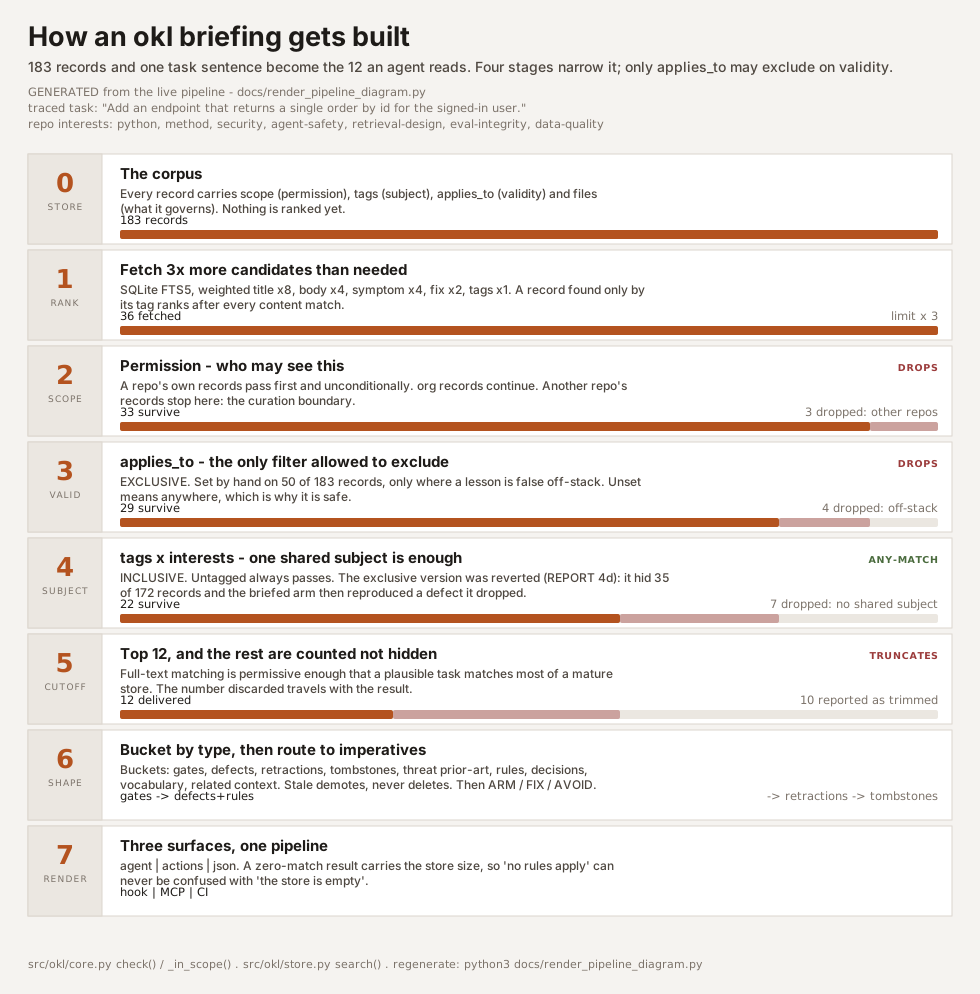
Every count in that diagram is traced, not transcribed — docs/render_pipeline_diagram.py
runs the real store.search and core._in_scope against a store seeded from seed/, and
test_pipeline_diagram_is_current fails if the committed render is not what the generator
produces today. Change a BM25 weight or a filter predicate and the diagram goes red with it.
The mental model
okl stores small, typed notes and the links between them.
A note (internally a "node") is one of a few kinds:
| Kind | What it captures |
|---|---|
| Defect | A specific bug or mistake that happened, and why. |
| Gate | An automated check that catches a class of defect. |
| Rule | A standard to follow ("do X, never Y"). |
| Retraction | A claim that turned out to be false and was withdrawn. |
| Tombstone | An identifier (name, file, endpoint) that was retired and must not come back. |
| Decision | A choice that was made deliberately, so it isn't silently reversed later. |
Each note can carry a Symptom → Cause → Fix: when you see this symptom, the cause is this, do this fix. That structure is what makes a note actionable instead of just informational.
Notes can be linked: a Gate CATCHES a Defect; a Retraction RETRACTS a Claim;
a Decision SUPERSEDES an older one. The links let a lookup pull in the connected
context ("here's the bug, and here's the check that would have caught it").
The two things you do
Everything reduces to two actions:
-
check— read before you work. You describe the task you're about to do.oklsearches the store, keeps only the notes relevant to your scope, ranks them, and returns a short briefing that leads with concrete actions: "FIX: server-controlled price tampering — when you see a request carrying a Price field → compute it server-side instead," "ARM: run the class-path check before you finish." Records that are not actions follow under their own headings, including the Decisions already made on purpose. An AI agent reads this at the top of its context; a person reads it in the terminal. -
record— write after you learn. When you fix something or decide something, you record it as a note (optionally with its symptom/cause/fix and the files it governs). From then on, everycheckwhose task resembles it surfaces it.
Scope — what stays local vs. what spreads
Every note has a scope, and this is the one decision that matters most:
repo:<name>— a lesson specific to one project. It only ever shows up for that project. (This repo's quirky build step, a workaround for one service.)org— a lesson that's true everywhere. It shows up for every project connected to the same instance. (A security pattern, an API contract, a data-source gotcha.)
Choosing the scope when you record is the human curation step. It's what keeps a
shared layer from filling up with one project's noise: another project's check
never sees your repo-scoped notes, only the org-scoped ones worth spreading.
Orthogonal to scope, every note can carry subject tags from a small controlled
vocabulary (react, security, eval-integrity, … — see KNOWN_TAGS in
store.py): scope answers who may see a note, tags answer what it's about.
A repo declares the subjects it cares about at init time
(okl init --interests "python-rag,eval-integrity"), and check then drops
org-wide notes tagged entirely outside those interests — so a Python eval task
isn't briefed on React lessons. Untagged notes and the repo's own notes always
pass. (Decision record: docs/decisions/2026-07-21-subject-tags-controlled-vocabulary.md.)
It fails closed
If okl is configured to talk to a shared instance and that instance is
unreachable, check says so loudly and blocks — it does not return an empty
"nothing found," because "no lessons apply" and "I couldn't reach the lessons" look
identical from the outside and the second one is dangerous. Silence is never
reported as safety.
Where the data lives
A single local file by default (SQLite). Point it at a shared service (backed by the same SQLite, or Postgres) when you want several repos to share one body of knowledge. The switch is one environment variable; none of your commands change.
Install as a Claude Code plugin
/plugin marketplace add emeraldleaf/okl
/plugin install okl@okl
The plugin carries the two hooks, the MCP tools and the seeding commands. It does not
carry okl itself: install the CLI first, with the MCP extra, because the plugin
registers the okl mcp server (pipx install 'observed-knowledge-ledger[mcp]'), then run
okl init in the repo for the store and the CI workflow — with the plugin enabled, init
skips the hooks and MCP registration, because registering them twice would brief every
prompt twice. okl doctor reports a repo where both the plugin and the project hooks are
active. To load the plugin from a checkout for one session: claude --plugin-dir <path>.
Install
pipx install observed-knowledge-ledger   # provides the `okl` command
pip install -e .                   # or from a clone of this repo
The core (local + client + CLI) is stdlib-only — zero required dependencies. Extras are opt-in:
pip install "observed-knowledge-ledger[service]"    # FastAPI shared service
pip install "observed-knowledge-ledger[postgres]"   # Postgres backend (psycopg)
pip install "observed-knowledge-ledger[mcp]"        # MCP server for Claude Code / Cursor / Copilot
pip install "observed-knowledge-ledger[all]"
What it costs, and how to turn it down
Installing okl is not free. It is worth knowing exactly what you are signing up for before you wire it into every prompt. Every number below was measured rather than estimated — on a fresh store holding the 161 seed records bundled at the time, with one representative task ("add an endpoint that returns an order for the logged-in user"; tokens ≈ characters ÷ 4). Your store and your tasks will differ.
Per prompt, once the hook is installed:
| Latency | ~0.1s for the whole okl check process (0.07s median warm) — one local SQLite query, no network in local mode |
| Context | ~1,650 tokens at the default --limit 12, down to ~230 at --format actions --limit 3 |
Per session: the Stop hook interrupts once at the end to ask what was learned. It blocks the first stop only, and answering it is the whole write side of the loop. With the question it lists up to five commands that failed during the session, read from the session's own transcript — candidates, not records: no hook runs on every tool call, and no model is called to summarise anything.
In your repo: okl init writes .okl/ (config, the local database, a .gitignore
covering both) and, when it wires Claude Code, two hook scripts plus their registration. In a
git repository it also installs .github/workflows/okl-verify.yml, which runs the drift
gate on every PR, unless you pass --no-ci.
CI has no store of its own (the local one is gitignored), so give it one: once a lesson
governs files, commit okl-drift.json (okl verify refreshes it; okl export --drift
writes it; a snapshot of the rules drift reads, no lesson bodies), or set the
OKL_SERVICE_URL secret. Without either, the step warns "Drift not checked" rather than
passing as if it had. Do not commit a snapshot holding zero rules: CI reads a configured
store that checked nothing as broken, and fails.
okl scaffold is separate and optional — nothing installs it unless you ask.
The knobs, cheapest first
okl check --task "..." --format actions   # imperatives only, about half the size
okl check --task "..." --format json      # the raw result, for scripts
okl check --task "..." --format hook      # what the Claude Code hook prints: the briefing plus
                                            #   the one-line notice you see (OKL_QUIET=1 drops it)
okl check --task "..." --limit 3          # fewer records; the briefing says how many it trimmed
okl init --interests "python,security"    # drop records tagged for stacks you do not use
--format actionsis the single biggest saving and loses the least: you keep every "when you see X → do Y" and drop the explanatory prose.--limit Ncaps how many records are drawn on. The full briefing reports how many it trimmed;--format actionsdoes not, so a short actions list can hide a miss without saying so.interestsis the one to reach for on a mature shared store. Tags filter inclusively — an org record passes when it is untagged or shares any one tag with your interests, so declaringpythonkeeps out a record tagged onlydotnet, but not one taggeddotnet,securitywhen you also declaredsecurity. Only a record'sapplies_toexcludes by stack.- Scope records
repo:rather thanorgwhen a lesson is local. Org scope is a claim that every project in the organization should see it, and it costs every project's budget to be wrong about that.
Turning parts off
OKL_QUIET=1 keeps the briefing but hides the one-line okl · briefed … notice. Switch a
hook off by name with OKL_DISABLED_HOOKS=briefing (the pre-task read),
OKL_DISABLED_HOOKS=encode (the end-of-session question), or both, comma-separated.
Set OKL_DISABLED_HOOKS=encode for headless runs (claude -p, CI agents, scripts):
print mode emits only the final message, and a blocked stop makes the reply to "what did
we learn?" that final message — the answer you asked for is then only in the transcript.
Hooks inherit the caller's environment, so the variable set on the claude command is
enough (evals/REPORT.md §10). The
pre-task hook is the read side and the Stop hook is the write side, and they are
independent — running the read without the write is a reasonable way to start, and turning
off encode is the usual choice beside a tool whose own Stop hooks already run.
Nothing is load-bearing on the hooks: okl check and okl record work from the terminal,
from CI, and through the MCP server whether or not any hook is installed.
To remove okl from a repo: okl init --uninstall (add --dry-run to preview). It removes
the two hook scripts, their exact entries in .claude/settings.json, okl's .mcp.json
server and .github/workflows/okl-verify.yml — and nothing else: another tool's hooks in
the same events stay, a file you edited is kept and named, and .okl/ (your store) is
never touched; delete it yourself if you mean to. Nothing outside the repo was ever written.
The two hook scripts and the CI workflow each carry a # okl-fingerprint: line, the hash
of the rest of the file (settings and .mcp.json are merged entry by entry instead). That
is how init and --uninstall tell an untouched okl file (of any fingerprinted version:
upgraded or removed freely) from one you edited. Files installed before 0.7 carry no
fingerprint, so unless one is byte-identical to the current version, init keeps it and
okl init --force is what upgrades it. init keeps an edited file unless you pass
--force; --uninstall always keeps it. There is no local state, so this works the
same for a teammate who cloned the repo. okl never writes through a symlink: a hook,
settings or workflow path that is a link, or sits under one, is refused and named.
Architecture review in CI (off by default)
The kit ships a reviewer that reads a PR diff against your encoded rules and fails the
build on a must-fix finding. It is off unless you ask for it, and it is not tied to any
vendor. Set the REVIEW_CMD repository variable to any CLI that reads a prompt on stdin:
gh variable set REVIEW_CMD --body "claude -p --model sonnet"   # Claude Code CLI, installed on the runner
gh variable set REVIEW_CMD --body "ollama run qwen2.5-coder"   # local model, no API cost
gh variable set REVIEW_CMD --body "llm -m gpt-4o"              # any other CLI
Two things worth knowing:
- In CI, the runner needs the CLI and a credential. The scaffolded job does not install
whatever
REVIEW_CMDnames, and if that command is not on the runner's PATH the step skips with a soft pass. Install it in the workflow and give it the secret it needs (the job passesANTHROPIC_API_KEYandOPENAI_API_KEYthrough when set). Your personal Claude Code login does not reach a hosted runner. - Run locally,
claude -pneeds no separate API key. It authenticates with the Claude Code login you already have. Verified headless withANTHROPIC_API_KEYunset. - Locally you do not need this at all. The reviewer is a subagent
(
.claude/agents/architecture-reviewer.md); ask your agent to run it on your changes and it costs nothing beyond the session you are already in. The CI job exists for the case where no human and no agent is in the loop — a PR nobody reviewed.
Unset, the step prints one line saying it is off and exits 0. Every other gate in the kit is deterministic and free; this is the only one that calls a model, which is why it is the only one that is opt-in.
Wire a repo
cd my-repo
okl init --repo my-repo        # writes .okl/config.json; wires Claude Code if .claude/ exists or `claude` is on PATH (--claude / --no-claude)
okl connect https://okl.myorg.dev   # optional: point at the shared service (else local file)
What okl init writes to your repo
Run okl init --dry-run first: it lists every path and writes nothing. In full, init
touches only the current directory, and only these:
| Path | What it is |
|---|---|
.okl/config.json | repo name, subject interests, and the path to your okl binary |
.okl/.gitignore | keeps .okl/ (config and store) out of git, with no edit to your own .gitignore |
.okl/okl.db | the local store (local mode only; seeded with the starter lessons and your stack's packs unless --no-seed) |
.claude/hooks/userpromptsubmit-okl-check.sh | executable; runs when you submit a task, injects the briefing |
.claude/hooks/stop-okl-encode.sh | executable; runs at session end, asks what was learned |
.claude/settings.json | registers those two hooks (merged in place; your existing keys are preserved) |
.mcp.json | registers the okl MCP server — only when the mcp extra is installed |
.github/workflows/okl-verify.yml | a CI workflow running the drift gate on pull requests — only in a git repository, and not with --no-ci |
Re-running init is safe as long as you pass the same --repo (without it, the repo name
resets to the directory's name): it upgrades okl's own files, keeps any you edited (say so
with --force to replace them), and merges settings without duplicating entries.
Two of those deserve a second look before you run it: the hooks are shell scripts that
execute automatically during agent sessions (the check hook can block a task when the
store is unreachable — that is the fail-closed design), and the CI workflow will run in
your Actions. Both are plain text you can read first, in
src/okl/scaffold/hooks/ and
src/okl/scaffold/ci/. Nothing executes at install time; nothing
is written outside the directory you run init in; nothing contacts a network unless you
run okl connect and point it somewhere yourself.
init writes .okl/config.json. When it wires Claude Code (the repo has a .claude/
directory, claude is on PATH, or you passed --claude), it also installs two hooks:
a UserPromptSubmit hook that runs check on
the prompt you actually typed and puts the briefing into the model's context (the
enforced read — it must be this event: PreToolUse stdout never reaches the model,
which an end-to-end test caught the hard way), and a session-end hook that blocks the first stop
of a session that changed files with one question — did this session learn anything
worth okl recording? — so the write side of the loop gets a mechanical prompt too,
not just a convention. It fires once per session and never loops.
Other agents (AGENTS.md): okl scaffold (not init) writes the repo canon to both
CLAUDE.md and AGENTS.md — one content, two filenames, so Codex/Cursor/anything
reading the AGENTS.md convention gets the same rules Claude Code does (byte-identity is
test-enforced). The hooks themselves are Claude Code-specific; other agents get the
canon via AGENTS.md and the store via the MCP server (okl mcp).
That split matters: on Claude Code the pre-task read is enforced (fail-closed hook);
everywhere else it is available (a tool call or a shell command), which is
discretionary — the thing enforcement exists to avoid. The hook scripts themselves are
plain bash reading JSON on stdin, so nothing in them is Claude-specific; what is missing
for other agents is the config that registers them, and whether the agent fires an event
early enough to matter. Codex CLI documents a userpromptsubmit hook, which is the right
shape; Copilot, Gemini CLI and Cursor have hook systems worth checking against your
version; OpenCode's plugin API captures tool events but, as of this writing, no
pre-prompt event — so there the read stays a tool call rather than a gate. Verify against
your agent's current docs before trusting any of that. Wiring one up is a well-shaped
contribution — see CONTRIBUTING.md.
Hooks run in whatever environment the agent harness spawns — often without your venv or
pipx bin dir on PATH — so both hooks resolve the okl binary in layers: the OKL_BIN
env var, then the okl_bin path init pins into .okl/config.json (machine-local),
then PATH, then any python3 that can import okl (python3 -m okl). If nothing
resolves, the check hook blocks with install instructions (fail closed, OKL_OFFLINE=1
to override) while the encode reminder silently disables (best-effort by design).
With no shared service configured it uses a local .okl/okl.db — single-machine
mode, good for trying it before you deploy anything.
Use it
# 1. READ the relevant lessons before starting a task (the load-bearing move)
okl check --task "add an endpoint that returns an order for the logged-in user"
#   add --format actions --limit 3 for a ~230-token version (subagents, CI)

# 2. RECORD a lesson after you learn it, with an actionable symptom/cause/fix
okl record --type Defect --scope org --tags "security" \
  --title  "Trusting a client-supplied price lets the client set it to anything" \
  --symptom "a request body carries a price/amount/status/isAdmin field" \
  --body    "cause: the handler saved the client's value instead of computing it" \
  --fix     "drop those fields from the request; compute them server-side" \
  --files   "**/orders/*.py"         # prints the new record's id

# ...then prove it with a check, rather than asserting it
okl verify <id> --run "pytest -q tests/test_orders.py" --expect "passed"

# 3. SEARCH the stored lessons directly
okl search "price tampering"

# 4. LINK a check to the defect it catches (so a lookup pulls in both)
okl link <gate_id> CATCHES <defect_id>
--symptom/--fix are what make check emit a leading "Do this" action list
("FIX: … — when you see: …") instead of a wall of prose. --files tells okl which
source files a lesson governs, which powers drift detection (below).
Extra commands
okl verify <id> --run "pytest -q" --expect "passed"
                     # run the named check and stamp the node verified ONLY on an observed
                     #   pass; the command + result is stored as the evidence trail.
                     #   --expect requires a positive success signal in the output, so an
                     #   exit code alone can't self-certify. (`record --verified` is
                     #   refused; historical receipts import through `okl seed`.)
okl reverify         # re-run the stored check of every drifted lesson and re-stamp the passes;
                     #   lists the commands first and runs them only after you confirm
                     #   (or --yes), because they come from the store; --dry-run lists only
okl drift --gate     # flag lessons whose governed source changed after they were last verified
                     #   (exit 1 in CI — a stale rule is a rule nobody's re-checked)
okl export --drift   # write okl-drift.json, the committed snapshot CI's drift gate reads
                     #   when it has no store; `okl verify` creates it for the first lesson
                     #   with --files and refreshes it after that.
                     #   CI reads the COMMITTED copy, and refuses an entry whose timestamp
                     #   does not match its verify evidence, so editing the timestamp alone
                     #   cannot clear it (editing both fields can; review is the guard).
okl doctor           # names other agent-memory tools installed beside okl (claude-mem,
                     #   agentmemory, ECC, beads) and how each collides with okl's hooks;
                     #   reads settings only, changes nothing. `okl init` says the same.
okl coverage         # ratio of encoded-knowledge lines to code lines — a health signal
okl bootstrap        # cold-start a new repo: propose starter notes from its own
                     #   git history + docs into a reviewable file you edit, then seed
okl metric           # recurrence: defect classes that came back, split by whether a
                     #   gate existed, with how many defects the number can speak for
Subagents and small context budgets
A full briefing costs roughly 1,650 tokens on the measurement above — fine for a main session with a large window, punishing for a subagent working in a few thousand. That asymmetry matters because subagents are exactly where org rules get lost: a focused worker handling one subtask has the least context and the most need for "here is the mistake this codebase already made."
--format actions solves it by dropping everything except the imperative list:
okl check --task "add an endpoint returning an order for the logged-in user" \
  --format actions --limit 3
OKL — 3 rule(s) apply before you start:
- FIX: Missing ownership scope check is an IDOR (CWE-639) [when: an endpoint fetches an
  entity by id with no owner/tenant predicate]
  -> add the caller's owner id to the WHERE clause; return 404 (not 403) on no match
...
Measured on the 161 seed records bundled at the time, one representative task: ~230 tokens at
--limit 3, ~380 at --limit 5, ~520 at --limit 8 and ~830 at --limit 12, against
~1,650 for the full briefing. Cheap enough to call per subtask.
The full briefing is itself capped: check keeps the top --limit records (12 by
default) from the ranked, filtered set and says how many it trimmed. Historically, before
that cutoff existed, one task on this repo's store at the time returned 20 records and
~4,400 tokens. The cutoff did
cost one retrieval: exit_code_trust's governing rule ranks below the top 12 for that
task's wording. Run outcomes hid it (the briefing still prevented the defect, through
other records); evals/preflight.py found it by asking directly whether each task's rule
is in its briefing, and it is kept in a named register rather than silently. See
evals/REPORT.md §4b's correction.
What it drops: the bucketed sections (Decisions among them), the prose bodies explaining why each record exists, prior-art notes, and the stale-record footer. What it keeps is what changes behaviour: the verb, the symptom to watch for, and the fix.
Wiring it into a subagent. Three ways, in order of how much enforcement you get:
- The MCP tool —
okl_check(task=..., compact=True, limit=3). Any subagent with MCP access can call it. Discretionary: the agent has to choose to. - In the subagent's prompt — have the spawning agent run
okl check --format actions --limit 3and paste the result into the subtask description. Not discretionary, and it costs the parent almost nothing. - A wrapper script that runs the check and prepends it to whatever prompt it is handed. This is the enforced version for orchestration you control.
A caveat worth stating. --limit caps how many records the briefing draws on, and
ranking decides which survive. If a task's most relevant rule ranks fourth and you ask
for three, you will not see it, and nothing will tell you. The full briefing exists
because it does not make that trade. Use the compact form where a token budget forces
the choice, not by default.
Verification: don't let a step grade itself
A step reporting "I succeeded" and the work actually being done are two different facts, and a loop that accepts the first one compounds garbage confidently. (The founding receipt: a pipeline step that was supposed to write 238 files failed on every one, swallowed the errors, and exited 0 — everything downstream ran happily on an empty folder.) Two clarifications that stop the common misreadings:
- The grader is usually
ls, not an LLM. Checking the work means observing the work product — files exist, counts match, tests ran, the output contains the success signal you named. Boring, deterministic checks. A second model only enters when the verify signal is itself a model's judgment (LLM-as-judge) — there, and only there, the judge must differ from the generator. - Not every step — every claim the loop acts on. Verify at decision boundaries (mark done, merge, deploy), cheap invariants in between.
okl applies this to its own knowledge in four escalating rungs:
- Assertion is refused at the CLI.
okl record --verified(a bare claim, no evidence) exits 2 and points atokl verify. Two doors stay open:okl seedimports historical, already-verified
Installation
Source-derived launch command. Check the maintainer’s required arguments and credentials before running:
uvx observed-knowledge-ledgerSet up in your AI client
Merge this template into ~/Library/Application Support/Claude/claude_desktop_config.json. Keep existing servers. Add any arguments, credentials, and permissions required by the maintainer; this template has not been install-tested.
{
  "mcpServers": {
    "io-github-emeraldleaf-okl": {
      "command": "uvx",
      "args": [
        "observed-knowledge-ledger"
      ]
    }
  }
}
Restart Claude Desktop completely for changes to take effect. Confirm the server appears connected in the client’s tool list, then try a read-only example from its documentation.
Claude Desktop setup referencePackage
Compatible MCP Clients
okl — Observed Knowledge Ledger works with any MCP-compatible client. Copy the config snippet from the Configuration section above and add it to the file shown for your client, then restart the application.
- Claude Desktop
~/Library/Application Support/Claude/claude_desktop_config.jsonRestart Claude Desktop completely for changes to take effect. - Cursor
~/.cursor/mcp.jsonRestart Cursor for changes to take effect. - VS Code
.vscode/mcp.jsonReload VS Code window for changes to take effect. - Windsurf
~/.codeium/windsurf/mcp_config.jsonRestart Windsurf for changes to take effect. - Claude Code
.mcp.jsonSave at the project root, then start Claude Code in that project and review the MCP server approval prompt. Keep real credentials out of shared files.