Metis
Governed tacit memory for AI agents: reviewed expert know-how, given only where conditions match
Metis is an open-source toolkit for capturing fragments of expert practice and making them available to AI agents as memory, with human review and agreed conditions for use.
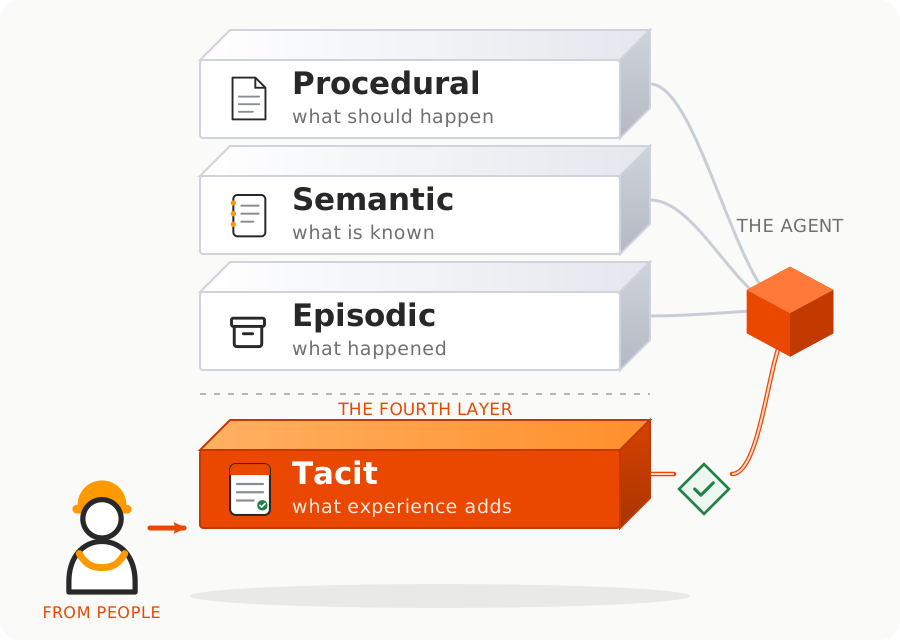
Tacit fragments: a fourth layer of agent memory
A tacit fragment records what an expert noticed, how they responded, and the circumstances of that response. After human review, it sits alongside procedures, facts, and past events in the agent's memory.
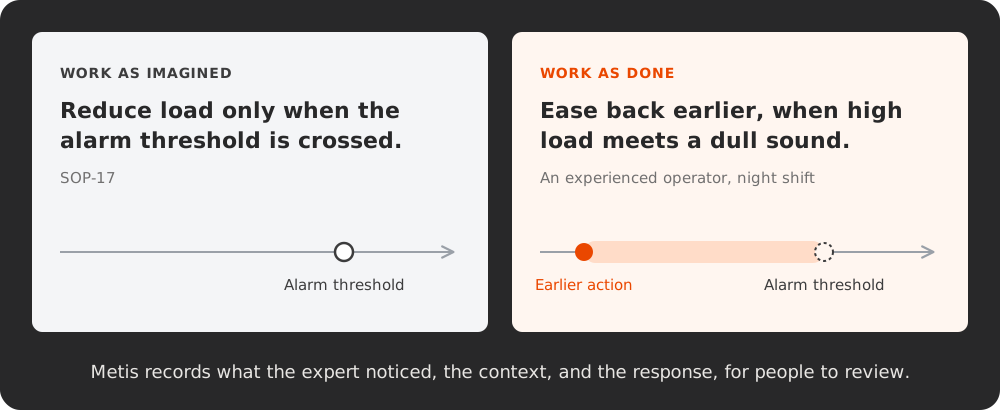
The gap between procedure and practice
Procedures describe what should happen, and logs record what happened. The cue behind an expert's decision, and the reason for it, often go unrecorded.
How a fragment reaches an agent
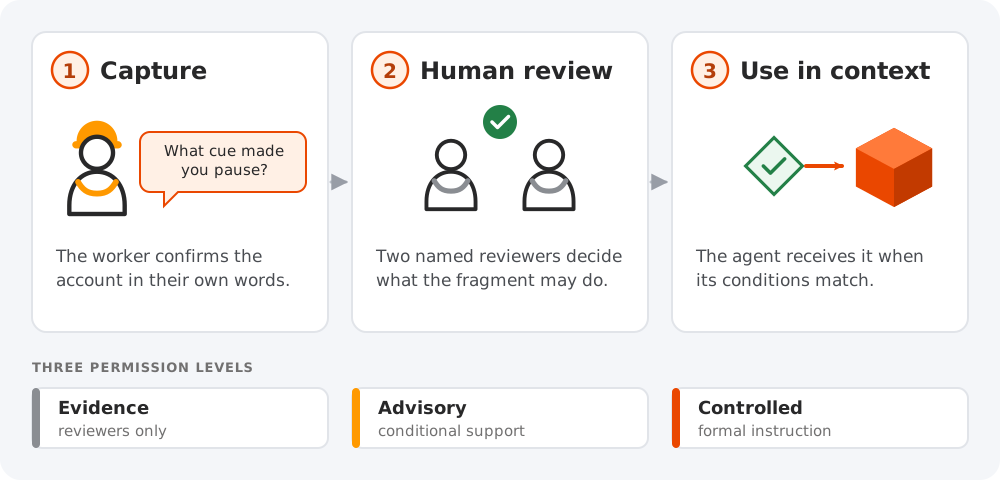
Every capture, confirmation, review decision, and retrieval is recorded through the
CHAP reference coordinator,
chap-coordinator, on a hash-linked evidence chain.
The capture loop
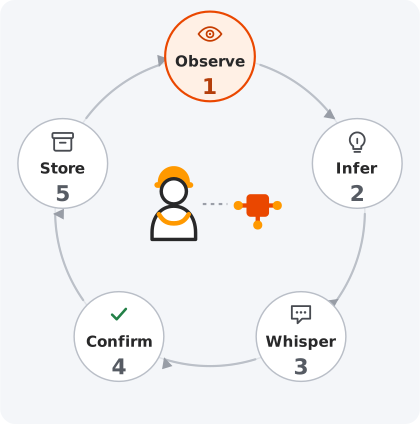
When a recorded action differs from the procedure, a capture agent asks the expert one short question, a whisper, and the expert confirms the account in their own words.
Seventeen kinds of know-how
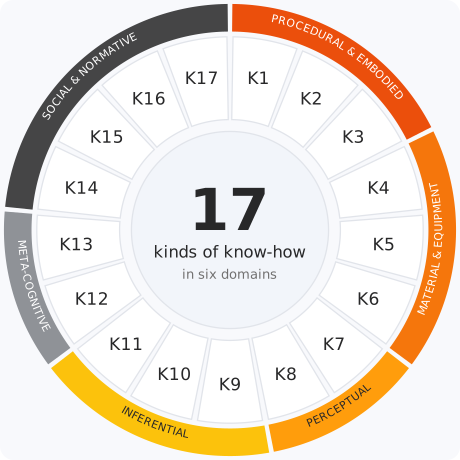
Each fragment carries one of the paper's seventeen categories of tacit knowledge, K1 to K17. The atlas on the website gives an example of each and a way to capture it.
Quickstart: run the pump example
python -m pip install metis-memory
metis demo manufacturing-pump-vibration
metis fragment list
metis memory list
metis audit verify
The demo uses supplied observations, needs no model server, and keeps its records in ./.metis.
To work from source:
git clone https://github.com/BrightbeamAI/metis && cd metis
pip install -e .
Python example: capture, review, and the condition-aware gate
from metis import MetisEngine
from metis.conditions.context import TacitContext
from metis.consent.model import ConsentRecord, ConsentStatus

eng = MetisEngine()  # local and deterministic
eng.join_default_participants()

# Capture the operator's practice where it departs from the procedure.
frag = eng.capture_observation(
    {
        "observation_id": "OBS-1",
        "work_as_imagined": "Reduce load only when the alarm threshold is crossed.",
        "work_as_done": "Ease back earlier, when high load meets a dull sound.",
        "context": TacitContext(equipment_family="centrifugal_pump", operating_mode="high_load"),
    },
    consent=ConsentRecord(consent_status=ConsentStatus.granted),
    category="K7_sensory",
).fragment  # Evidence layer: reviewers only

# Two named reviewers promote it to Advisory.
eng.tier2_review(
    frag.fragment_id, "promoted_to_advisory", summary="advisory cue only",
    decided_by=["human:quality-lead@metis.local", "human:process-engineer@metis.local"],
)

# The gate returns it only where its conditions hold.
pump = TacitContext(equipment_family="centrifugal_pump", operating_mode="high_load", risk_class="moderate")
other = TacitContext(equipment_family="gear_pump", operating_mode="low_load", risk_class="moderate")
print(len(eng.retrieve(pump).eligible))       # 1
print(eng.retrieve(other).blocked[0].reason)  # conditions_do_not_match
Connect Metis to your application
| Area | Metis provides | Your application supplies |
|---|---|---|
| Capture | Fragment schemas and the whisper flow | Capture tools, consent workflows, and access control |
| Review | Confirmation, review, and authority records | Reviewer identity and formal change control |
| Retrieval | The condition-aware gate and its reasons | Current context, permissions, and domain policies |
| Action | Guidance with its permitted uses | Action limits and human escalation |
| Records | Local persistence and CHAP evidence | Storage, retention, and access policy |
metis mcp serves the same governed memory to MCP clients such as Claude Desktop and Claude Code,
and uvx metis-memory mcp runs it with nothing installed first. See the
MCP server guide. To run Metis for a team, the
server guide covers sign-in, workspace roles, the web app, and PostgreSQL;
deploy/ runs it with Docker or Kubernetes; and the
agent integrations guide connects agents through remote MCP, a
Python client, or LangChain. Connectors capture from workplace systems
and put whispers in Slack or Teams, and the operations guide covers running
it in production.
Learn more
- Website: the interactive walkthrough, the atlas, and common questions.
- Documentation: architecture, governance, retrieval, and agent use.
- ABOUT.md: the repository map and how to develop.
- CHAP: the Collaborative Human-Agent Protocol.
docs/demo.htmlanddocs/explainer.html: an interactive demo and an illustrated explainer that open in any browser.
Ethical use
Metis captures fragments of human work with the worker's knowledge and consent. Do not use it for covert monitoring. It records no audio, video, biometrics, screenshots, or keystrokes. Production use needs worker consultation, legal review, and domain validation; read ETHICAL_USE.md first.
License
Apache-2.0. See LICENSE.
Citation
Metis is the reference implementation of Tacit Fragments: Operationalising Tacit Knowledge as a Governed Memory Layer for Agentic AI.
@article{shahid2026tacitfragments,
  title   = {Tacit Fragments: Operationalising Tacit Knowledge as a Governed Memory Layer for Agentic AI},
  author  = {Shahid, Arsalan and Suttie, Gordon and Black, Philip and Garz{\'o}n-Vico, Antonio},
  journal = {Preprints},
  year    = {2026},
  doi     = {10.20944/preprints202608.0927.v1},
  url     = {https://metis.brightbeam.works/resources/tacit-fragments-preprint.pdf}
}
Installation
Source-derived launch command. Check the maintainer’s required arguments and credentials before running:
uvx metis-memorySet up in your AI client
Merge this template into ~/Library/Application Support/Claude/claude_desktop_config.json. Keep existing servers. Add any arguments, credentials, and permissions required by the maintainer; this template has not been install-tested.
{
  "mcpServers": {
    "io-github-brightbeamai-metis": {
      "command": "uvx",
      "args": [
        "metis-memory"
      ]
    }
  }
}
Restart Claude Desktop completely for changes to take effect. Confirm the server appears connected in the client’s tool list, then try a read-only example from its documentation.
Claude Desktop setup referencePackage
Compatible MCP Clients
Metis works with any MCP-compatible client. Copy the config snippet from the Configuration section above and add it to the file shown for your client, then restart the application.
- Claude Desktop
~/Library/Application Support/Claude/claude_desktop_config.jsonRestart Claude Desktop completely for changes to take effect. - Cursor
~/.cursor/mcp.jsonRestart Cursor for changes to take effect. - VS Code
.vscode/mcp.jsonReload VS Code window for changes to take effect. - Windsurf
~/.codeium/windsurf/mcp_config.jsonRestart Windsurf for changes to take effect. - Claude Code
.mcp.jsonSave at the project root, then start Claude Code in that project and review the MCP server approval prompt. Keep real credentials out of shared files.